Hair Levels Testing threshold / cut off levels ....Standard 5 Panel
Drug......Threshold/cutoff........Low use (recreational) .......Medium use (daily/weekends) ......High use(constant)
THC - ............1.0pg (0.01ng/10mg) ........................... 3pg ----------------------------------- 7pg --------------------------- 30+pg
Amphetamines ...300pg/mg (3ng/10mg) . 500-2500pg ................................... 2500-7500pg ..............................7500+pg
Cocaine ...............500pg/mg (5ng/10mg) . .... 500-2000pg ...................................2000-10000pg ............................ 10000+pg
Opiates 300pg/mg (2ng/10mg) ................ ... 300-1000pg .......................................2000-8000pg ...............................9000+pg
Phencyclidine 300pg/mg (3ng/10mg)........... 300-500pg ...........................................500-1000pg .................................2000+pg
Use Amounts vs Levels vs Treatment
THC is not cut and dry like all others only giving monthly vs grams
1 g a day / 1 oz a month average 2.5 pg levels - Concentrate go by 4 x rule so a gram of wax is 4 grams dry
1 g a day / 1 oz a month average 2.5 pg levels - Concentrate go by 4 x rule so a gram of wax is 4 grams dry
Meth - ( includes MDMA , or any amphetamine medication such as adderal ) 1-gram use results 10,000pg
Coke - 1-gram results 1,000pg COC yet is the most work to break down
OPIATES - 8 treatments per gram as in the mg per pill as in a 10/250 perc only the 10mg is the opiate so 100 10mg is 1g
REGARDING SELF TEST SERVICES and what Testing screens cover
PSYCHEMEDICS pdt90 is preferred for COCAINE as they use a lower cutoff (200pg vs 500 at Hair Confirm ) however dont think they give qualitative ( Actual levels ) read out verify if quantitative or just positive negative .
Hair Confirm has quantitative results for everything even if below threshold ( however cocaine cut off is is 500pg )
Hair Confirm has quantitative results for everything even if below threshold ( however cocaine cut off is is 500pg )
WE SUGGEST THIS PRODUCT AS THEY USE QUANTITATIVE RESULTS NOT JUST A POSITIVE OR NEGATIVE WE NEED ACTUAL LEVELS THEY TELL US EVERYTHING

Hair Confirm Web Site Link
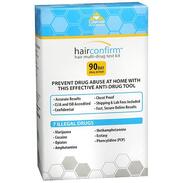
Hair Confirm 7 Panel Self Test
Regular / Express regular is much cheaper than express all depends on your situation CVS store locator |
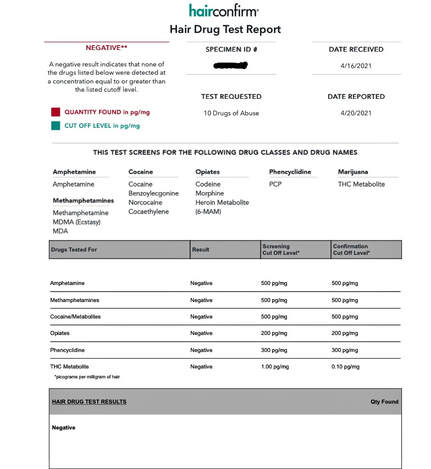
Hair Razor Negative Hair Result
|
Hair collection & Testing Information
"Standard " Hair Test are run on a 5 panel screen. Some bigger labs like Quest, in order to get bigger fail numbers will use "extended opium panel" Normally a 5 panel looks at natural opiate like heroin morphine and codeine. The extended panel included oxycodone Percocet type meds as well. The more exotic meds like deladide or Methadone are on 10 panel screens and up. Cost are greater so with larger panels so it is rare. Typically your already in a situation and shouldn't be using anyway .
5 Panel - The Standard
Amphetamines (speed, meth )
Opiates (heroin, morphine, opium, codeine)
11-nor -D9-THC-9 Cannabinoids ( THC)
Cocaine ( actually screens for 2 cocaine metabolite and cocaine itself)
Phencyclidine (PCP)
Opiates (heroin, morphine, opium, codeine)
11-nor -D9-THC-9 Cannabinoids ( THC)
Cocaine ( actually screens for 2 cocaine metabolite and cocaine itself)
Phencyclidine (PCP)
9 Panel Hair screen - Or opiate extended panel
Amphetamines (speed, meth, crank)
11-nor -D9-THC-9 Cannabinoids ( THC)
Cocaine ( actually screens for 2 cocaine metabolite and cocaine itself)
Opiates ( Heroin, Morphine, Codeine)
Phencyclidine (pcp)
Benzodiazepines
Oxycodone ( hydrocodone, percocete, Oxycontin )
Methadone
Propoxyphene
11-nor -D9-THC-9 Cannabinoids ( THC)
Cocaine ( actually screens for 2 cocaine metabolite and cocaine itself)
Opiates ( Heroin, Morphine, Codeine)
Phencyclidine (pcp)
Benzodiazepines
Oxycodone ( hydrocodone, percocete, Oxycontin )
Methadone
Propoxyphene
Opiates
(heroin, codeine, morphine)
Expanded Opiates
– Hydrocodone
– Hydromorphone
– Oxymorphone
– Oxycodone
12 Panel Hair Drug Test
- Opiates,Methamphetamine,Cocaine,Marijuana,PCP,Amphetamines,Barbiturates,Benzodiazepines,
- expanded Opiates, Oxycodone, Methadone, Meperidine, Tramadol
12 panel hair drug test is more expensive and not available at all labs. This particular hair test is typically ordered for court cases .
Hair Collection Procedure
Typical amount of hair is 90 -120 strands from .5" to 1.5" , hair over 1.5" will be trimmed by tech before process to 1.5" . This is part of standardization of testing. So, @ .5" they will just use a little more hair so all sample weight the same. They can only see what you give them , at .5" ( average 1 month window) they can't see 3 months or more let alone a year . Cutting hair from 12 " to 6" will do nothing , wait to be instructed by tech if hair cutting will help in your case .
Hair is collected in 2 typical ways depending on the labs SOP . Some collect from a few random spots and someone swatch from rear. More often from crown and back as to not create a spot or mess up haircut. Generally concentrating treatment on rear of head for woman is ideal. Men with high top cuts will be collecting from top or wherever the longest hair is at so they can get the full 1.5" 3-month window if possible .
Hair is collected in 2 typical ways depending on the labs SOP . Some collect from a few random spots and someone swatch from rear. More often from crown and back as to not create a spot or mess up haircut. Generally concentrating treatment on rear of head for woman is ideal. Men with high top cuts will be collecting from top or wherever the longest hair is at so they can get the full 1.5" 3-month window if possible .
This video is an example of typical hair collection procedure .
OPIOIDS
Urinalysis testing is commonly used to detect the presence of opiates in the body, whether they are obtained through prescription or illicit means. One of the primary substances that is identified in these tests is morphine, which is a metabolite of heroin and codeine. Morphine undergoes further metabolic processes and is broken down into two main substances: 3-morphine-glucuronide and 6-morphine-glucuronide. The 3-morphine-glucuronide metabolite is responsible for approximately 50% of the morphine that is excreted through the kidneys. However, this metabolite can have adverse effects such as hyperalgesia and neurotoxicity.
Fentanyl, a potent opioid, is typically not detected in urine screens due to the lack of identifiable metabolites. Similarly, oxycodone is not usually detected because it is derived from the baine, a compound that is not excreted in the urine. On the other hand, codeine undergoes extensive metabolism, and approximately 10% to 15% of the administered dose is converted into morphine and norcodeine. All three of these compounds can be detected in the urine following their ingestion.
While prescribed opiates are intended for pain management purposes, illicit substances and semi-synthetic derivatives of morphine are not used for therapeutic effects due to their high potential for abuse. Heroin, for example, is a semi-synthetic derivative of morphine that is more potent and acts rapidly. It binds to the opioid receptor as an agonist, inhibits substance P, and produces effects similar to prescribed opiates, including sedation, miosis (constriction of the pupils), nausea or vomiting, and decreased blood pressure, heart rate, and respiratory rate.
Detecting the presence of heroin itself can be challenging because it is rapidly metabolized into several substances, including 6-monoacetylmorphine (6-MAM), morphine, and morphine glucuronide. Heroin can be detected in the bloodstream within 3 to 5 minutes after administration, while the metabolite morphine can be detected 2 to 4 days after heroin use. Confirmation through gas chromatography-mass spectrometry (GC-MS) is necessary to confirm suspected heroin use, and the presence of 6-MAM is considered conclusive evidence. The 6-MAM metabolite specifically indicates heroin use, as it is not produced from morph
Urinalysis testing is commonly used to detect the presence of opiates in the body, whether they are obtained through prescription or illicit means. One of the primary substances that is identified in these tests is morphine, which is a metabolite of heroin and codeine. Morphine undergoes further metabolic processes and is broken down into two main substances: 3-morphine-glucuronide and 6-morphine-glucuronide. The 3-morphine-glucuronide metabolite is responsible for approximately 50% of the morphine that is excreted through the kidneys. However, this metabolite can have adverse effects such as hyperalgesia and neurotoxicity.
Fentanyl, a potent opioid, is typically not detected in urine screens due to the lack of identifiable metabolites. Similarly, oxycodone is not usually detected because it is derived from the baine, a compound that is not excreted in the urine. On the other hand, codeine undergoes extensive metabolism, and approximately 10% to 15% of the administered dose is converted into morphine and norcodeine. All three of these compounds can be detected in the urine following their ingestion.
While prescribed opiates are intended for pain management purposes, illicit substances and semi-synthetic derivatives of morphine are not used for therapeutic effects due to their high potential for abuse. Heroin, for example, is a semi-synthetic derivative of morphine that is more potent and acts rapidly. It binds to the opioid receptor as an agonist, inhibits substance P, and produces effects similar to prescribed opiates, including sedation, miosis (constriction of the pupils), nausea or vomiting, and decreased blood pressure, heart rate, and respiratory rate.
Detecting the presence of heroin itself can be challenging because it is rapidly metabolized into several substances, including 6-monoacetylmorphine (6-MAM), morphine, and morphine glucuronide. Heroin can be detected in the bloodstream within 3 to 5 minutes after administration, while the metabolite morphine can be detected 2 to 4 days after heroin use. Confirmation through gas chromatography-mass spectrometry (GC-MS) is necessary to confirm suspected heroin use, and the presence of 6-MAM is considered conclusive evidence. The 6-MAM metabolite specifically indicates heroin use, as it is not produced from morph
Luck's get clean shampoo—product FAILED….He informed me I was 2.5 … over the minimum cut off. https://www.420magazine.Com/forums/420-drug-testing/68361-hair-detox-products-any-input.Html
“I tried the home remedy of shampooing with tar shampoo, vinegar, clay and pink salicylic acid. I washed twice daily for a week solid, scrubbed in salt etc. no go! I failed.”Hair follicle test info.Com
“I followed the pre-treatment instructions to a “T”. For 2 weeks before I used the treatment, I washed my hair with Nexxus’ aloe rid. I thought all of this would have been sufficient. It failed miserably.”https://www.420magazine.Com/forums/420-drug-testing/68361-hair-detox-products-any-input-3.Html
I recently purchased and used “toxin wash” shampoo in order to secure a better job. I had not used in nearly 2 months. … I was positive for THC. https://www.420magazine.Com/forums/420-drug-testing/68361-hair-detox-products-any-input-3.Html
The cut off is 0.01 pg of THC detected in the hair. … I still got a 3.25, yeah- NOT EVEN CLOSE. At that point my hair had been washed with 3 products multiple times that all claimed to clean your hair by itself and they did not get me anywhere near passing. ….After using bleach and all that stuff on my hair I had a sore spot on the back of my head that developed into shingles. So, I wound up with $800 in hospital bills from that since I did not have health insurance at the time.https://www.420magazine.Com/forums/420-drug-testing/68361-hair-detox-products-any-input-3-print.Html
“I tried the home remedy of shampooing with tar shampoo, vinegar, clay and pink salicylic acid. I washed twice daily for a week solid, scrubbed in salt etc. no go! I failed.”Hair follicle test info.Com
“I followed the pre-treatment instructions to a “T”. For 2 weeks before I used the treatment, I washed my hair with Nexxus’ aloe rid. I thought all of this would have been sufficient. It failed miserably.”https://www.420magazine.Com/forums/420-drug-testing/68361-hair-detox-products-any-input-3.Html
I recently purchased and used “toxin wash” shampoo in order to secure a better job. I had not used in nearly 2 months. … I was positive for THC. https://www.420magazine.Com/forums/420-drug-testing/68361-hair-detox-products-any-input-3.Html
The cut off is 0.01 pg of THC detected in the hair. … I still got a 3.25, yeah- NOT EVEN CLOSE. At that point my hair had been washed with 3 products multiple times that all claimed to clean your hair by itself and they did not get me anywhere near passing. ….After using bleach and all that stuff on my hair I had a sore spot on the back of my head that developed into shingles. So, I wound up with $800 in hospital bills from that since I did not have health insurance at the time.https://www.420magazine.Com/forums/420-drug-testing/68361-hair-detox-products-any-input-3-print.Html